
Self-Esteem as Wellness: Why How We See Ourselves Shapes How We Live

Updated: Jul 1

Wellness is often spoken about in terms of habits.
Sleep better. Eat well. Exercise more. Manage stress. Drink enough water. Go for health screenings. Take your supplements. Breathe. Stretch. Rest. All of these matter. But beneath many of these choices is something quieter, more personal, and often harder to talk about:
Do I believe I am worth taking care of? Or why should I take good care of myself?
What is Self-Esteem?
That is where self-esteem enters the conversation. If you feel that you are not worth taking care of, then at the end of the day, you might not progress much in your self-care journey. Self-esteem is not about thinking you are better than other people. It is not arrogance, vanity, or pretending to be confident all the time. Real self-esteem is much more than that. It is the ability to look at yourself with some form of basic kindness. It is the belief that your life has value, your needs matter, and your body and mind deserve care — even on the days when you feel tired, flawed, ageing, uncertain, or not at your best. Because the way we see ourselves often shapes the way we treat ourselves. So, be kind to yourself.
A person with healthy self-esteem may still have bad days. They may still feel insecure. They may still compare themselves with others, make mistakes, or struggle with disappointment. But they are less likely to turn every difficult moment into a personal verdict. They can say, “I made a mistake,” without immediately deciding, “I am a failure.” They can feel rejected without believing they are unlovable. They can feel tired without calling themselves weak. That small difference matters a lot.
Why Self-Esteem Matters for Mental Health
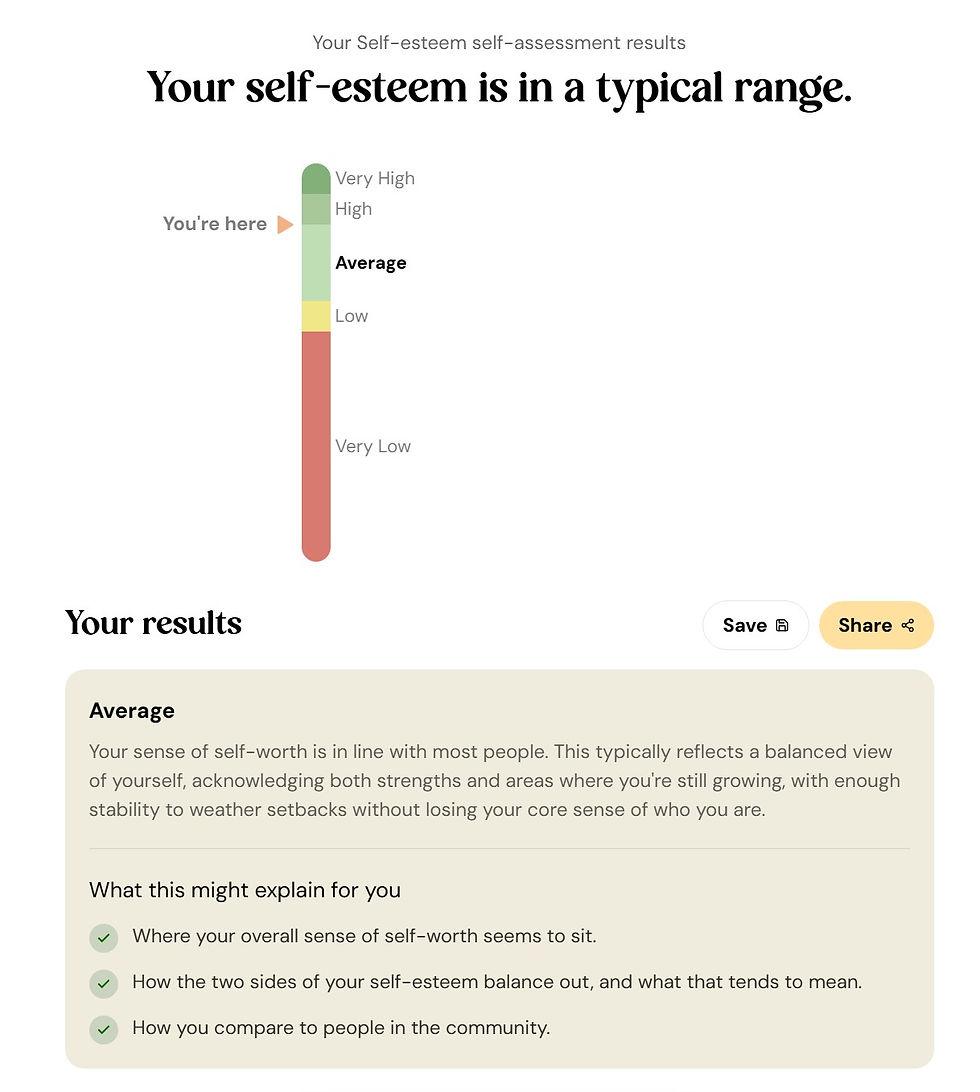
In psychology, self-esteem is often understood as our overall sense of self-worth. One of the best-known tools used in research is the Rosenberg Self-Esteem Scale, which looks at how much self-respect and self-acceptance a person feels. Over the years, research has linked self-esteem with many parts of wellbeing, including mental health, relationships, motivation, and health-related behaviours. Low self-esteem is not simply “feeling bad about yourself.” It can quietly affect how a person experience the world. A passing comment may feel like a stinging criticism. A small mistake may feel like proof that you are really not good enough. Someone not replying to a message may feel like a personal rejection. A tired, unproductive day may feel like personal failure, especially you didn't make it to the gym again due to a stressful work day or school.
Over time, this can become exhausting. The mind becomes a harsh place to live in. Instead of being a source of support, the inner voice becomes another stressor. This is one reason self-esteem matters for mental health. Research has found that low self-esteem is linked with higher risk of depression and anxiety. Biology, sleep, trauma, relationships, physical health, stress, environment, and life circumstances all matter. But self-esteem appears to be one important part of the picture.

The Link Between Low Self-Esteem, Depression and Anxiety
When someone feels “not enough” for a long time, the body can also feel the strain. The body does not only respond to physical threats. It also responds to emotional ones. Constant self-criticism, shame, comparison, chronic stress and fear of not measuring up can keep the nervous system on alert. Over time, chronic stress can affect sleep, mood, energy, immune function, and overall wellbeing.
This does not mean we can cure everything by thinking positively. That would be too simple, and also unfair. But it does mean the stories we repeat to ourselves are not harmless. A cruel inner voice can wear us down. A kinder one can help us recover.
Self-esteem also affects the way we care for our health.

When you believe you are worth caring for, it becomes easier to make choices that protect your wellbeing. You are more likely to rest when you are tired. You are more likely to go for a check-up instead of ignoring symptoms. You are more likely to set boundaries, leave unhealthy situations, ask for help, eat in a nourishing way, and move your body with respect.
But when self-esteem is low, self-care can feel undeserved. A person may neglect their health, overwork, withdraw from others, or give up easily because a part of them feels, “What’s the point?”, or "I'm not worth improving".
Self-Esteem: You Matter
This is why self care should never be only about discipline. Sometimes the issue is not that a person lacks motivation. Sometimes the deeper issue is that they have forgotten they are allowed to matter. Exercise is a good example.
Movement is often sold as a way to change the body. Lose weight. Look better. Burn calories. Feel younger. But movement can also be something much more meaningful. It can be a way of rebuilding trust with yourself. A walk can remind you that your body is still carrying you. Strength training can remind you that you are capable of growth. Stretching can become a quiet message to your body: “I am listening.” Research has shown links between physical activity and self-esteem, partly through improvements in mood, body image, confidence, and a sense of ability. But the intention matters.
Moving your body because you hate it feels very different from moving your body because you respect it. Self-esteem is also shaped by the people and spaces around us. Very few of us develop our sense of worth alone. We learn it through our parents, family, school, friendships, work, culture, relationships, and social media. We learn it from the way people speak to us. We learn it from whether we feel seen, safe, respected, or constantly judged.

Self-Esteem and Healthy Lifestyle Choices
This is why a wellness journey is not always about adding more healthy habits. Sometimes it is about removing what keeps hurting you. A toxic workplace. A relationship where you are constantly made to feel small. A social media feed that leaves you feeling inadequate. A lifestyle built around proving yourself to everyone except yourself.
Healthy self-esteem grows better in environments where dignity is protected. There is also an important difference between real self-esteem and fragile self-esteem. Fragile self-esteem depends on achievement, beauty, praise, money, success, or being admired. It feels good when life is going well, but it collapses quickly when something goes wrong. Real self-esteem is steadier. It allows you to enjoy success without needing it to define you. It allows you to admit weakness without hating yourself. It allows you to grow without constantly attacking who you are now.
This is especially important in today’s health and wellness culture. We are surrounded by messages telling us to improve. Improve your body. Improve your sleep. Improve your productivity. Improve your skin. Improve your lifespan. Improve your morning routine. There is nothing wrong with personal growth. But wellness culture can become unhealthy when it turns into another reason to feel inadequate. Like, I feel so fat compared to the fitness influencers.
You Don't Have to be Perfect
You do not have to become a completely different person before you are worthy of care. You are allowed to care for yourself now. So how do we build healthier self-esteem?
For some people, therapy can help. Cognitive behavioural therapy, or CBT, has been studied as one approach for low self-esteem. It can help people notice harsh beliefs, question unhelpful thought patterns, reduce avoidance, and slowly build new evidence that they are more capable than they believed.
But self-esteem is also built in ordinary moments.
Keeping a small promise to yourself. Speaking to yourself with less cruelty. Resting without guilt. Saying no when something costs too much of your peace. Accepting a compliment instead of rejecting it. Spending time with people who make you feel more like yourself. Choosing food, movement, and routines from a place of care rather than punishment.
Positive self-esteem does not mean you will never doubt yourself again.
It means doubt no longer gets the final word.
In the end, self-esteem is one of the quiet foundations of wellness. It is what helps us believe that our health matters. That our rest matters. That our future matters. That our body is not just something to fix, but something to care for. That our life is not something to constantly prove, but something to inhabit with more gentleness.
Wellness is not only about living longer.
It is also about learning to live with yourself more kindly.
And sometimes, that is where true healing begins.


Comments